Daylilies provide British gardeners with a dependable option for extending summer displays. These perennials produce lily-like flowers in a spectrum of hues, each bloom lasting a single day yet appearing in such abundance that the effect remains continuous over weeks. In the UK’s temperate climate, where summers can fluctuate between mild warmth and unexpected rain, daylilies stand out for their resilience. They tolerate a range of soils, from heavy clay to lighter loams, and require minimal intervention once established. The Royal Horticultural Society has recognised numerous cultivars through its Award of Garden Merit, affirming their suitability for domestic plots across regions from the damp west to the drier east.
Selecting varieties adapted to British conditions ensures consistent performance. Factors such as hardiness to frost, resistance to wet summers, and ability to flower under partial shade influence success. For those new to these plants, starting with proven selections simplifies the process. Daylily plants for sale from specialist nurseries often come bare-root or potted, ready for immediate planting in spring or autumn. This accessibility makes them ideal for gardeners seeking low-effort colour without the demands of more tender exotics.
As the premier grower of daylily plants, SwallowtailDaylilies emphasises the importance of choosing cultivars with strong branching stems to withstand wind and rain. “These attributes ensure reliable blooming even in our variable weather,” they advise. For guidance on robust options, consider daylily varieties, where detailed listings highlight those bred for temperate zones.
This article examines seven such varieties, all holding the RHS Award of Garden Merit. Each offers distinct qualities, from fragrance to vigour, enabling gardeners to create layered borders or focal points. By incorporating these, plots gain structure and seasonal interest, complementing shrubs like hydrangeas or grasses such as miscanthus.
The Advantages of Growing Daylilies in the UK
Daylilies align well with the practical needs of British gardening. Their clump-forming habit fills spaces effectively, reaching heights from 50cm to over 1m, depending on the cultivar. This versatility suits small urban yards as much as larger rural borders. In a climate prone to overcast days, they manage with four to six hours of sun, flowering adequately in light shade where stronger sun-lovers might scorch.
One key benefit lies in their hardiness. Most daylilies are deciduous in the UK, dying back naturally in autumn to re-emerge in spring without winter protection. Evergreen types, though less common here, provide year-round foliage but demand sharper drainage to avoid rot in wet spells. Their root systems, fibrous and extensive, anchor against gusts common in exposed areas like coastal gardens or Scottish highlands.
Ecologically, daylilies support pollinators. Nectar-rich blooms attract bees and hoverflies during peak summer, contributing to garden biodiversity. Unlike some ornamentals reliant on chemicals, they rarely suffer serious pests; occasional aphids or slugs can be managed with organic barriers like grit mulches. This low-maintenance aspect appeals to time-strapped homeowners, who appreciate plants that thrive on neglect once settled.
Financially, daylilies offer value. A single division can multiply into several plants within three years, reducing replacement costs. Nurseries stock them affordably, with mature specimens yielding dozens of scapes—flowering stems—per season. In terms of aesthetics, their trumpet-shaped flowers add vertical interest, contrasting with low-growing alpines or trailing ivies. Gardeners in southern counties report blooms from June to September when mixing early and late types, effectively doubling the display period.
Comparatively, daylilies outperform alternatives like lupins, which falter in humid conditions, or delphiniums needing staking. Their adaptability to pH levels, from acidic peaty soils in Wales to alkaline chalk in Kent, broadens their appeal. Studies from horticultural trials confirm yields of 200 to 400 flowers per mature clump annually, ensuring no bare patches mid-season. For borders planned around native schemes, they integrate seamlessly, their grassy foliage echoing meadow perennials.
Overall, these plants embody efficient gardening: robust, rewarding, and regionally attuned. Incorporating them enhances plot resilience against climate shifts, such as warmer winters or heavier rains, projected for coming decades. Gardeners report satisfaction from their predictability, fostering confidence to experiment further.
Preparing Your Garden for Daylilies
Site selection forms the foundation for daylily success in Britain. Aim for positions with morning sun and afternoon shelter to mitigate scorching in hotter spells, though northern exposures work if drainage is sound. Test soil by digging a hole; if water pools after rain, amend with grit or compost to prevent crown rot, a rare but avoidable issue.
Planting timing matters. Spring arrivals allow root establishment before summer drought, while autumn divisions settle over mild winters. Prepare beds by forking in organic matter—well-rotted manure or leaf mould—to a depth of 30cm. Space plants 45-60cm apart, depending on mature spread, to accommodate clumping without competition. Bare-root stock should be soaked briefly before insertion, crowns 2-3cm below soil level.
Watering follows a measured approach. New plants need consistent moisture for the first season, about 2.5cm weekly if rainfall lags. Established ones cope with dry periods, drawing on deep roots, but mulching with bark conserves soil dampness and suppresses weeds. Fertiliser applications, if used, should be balanced NPK formulas in early spring, avoiding excess nitrogen that promotes foliage over flowers.
Pruning maintains tidiness. Remove spent scapes at the base to redirect energy, and cut back foliage in late autumn once browned. Division every three to four years rejuvenates vigour; use a sharp spade to split clumps, replanting sections promptly. This practice also propagates stock for free, ideal for expanding collections.
Pest vigilance remains straightforward. Slugs favour young shoots, countered by beer traps or copper tape. Hemerocallis gall midge, though uncommon, distorts buds; affected stems warrant removal and disposal. Rust, once a concern from imports, poses minimal threat in monitored UK gardens. Companion planting with alliums deters aphids naturally.
Winter care simplifies further. A light mulch of compost shields against hard frosts in elevated areas, though most cultivars endure down to -15°C. In container growing, popular for patios, elevate pots on feet to avert waterlogging. Regular deadheading extends blooms, a task taking mere minutes weekly.
By addressing these basics, gardeners secure long-term yields. Trials show properly sited daylilies outlasting many perennials, providing returns for minimal input. This preparation suits both novices and seasoned cultivators, yielding gardens that flourish amid Britain’s mercurial seasons.
Early-Season Stars: ‘Stoke Poges’ and ‘Whichford’
Among early bloomers, Hemerocallis ‘Stoke Poges’ delivers coral-salmon petals veined in dark tones, accented by apricot splashes and white midribs. Reaching 70cm, its fragrant trumpets emerge in June, persisting through mid-summer on sturdy stems. This deciduous variety excels in mixed borders, pairing with rudbeckias for a sunset palette. Its vigour suits clay-heavy soils in the Midlands, where it withstands prolonged damp without fading. Gardeners value its substance, ensuring petals hold shape in showers.
Complementing this, Hemerocallis ‘Whichford’ offers pale lemon flowers, trumpet-formed from green buds with a green throat. At 70cm, its upright scapes carry sweetly scented blooms from early June, ideal for cutting. Deciduous foliage forms neat clumps post-bloom, easing autumn cleanup. It thrives alongside dark salvias or pink penstemons, adding luminosity to shaded corners in eastern counties. Breeders note its tolerance for partial shade, a boon in overcast northern plots.
Both selections demonstrate daylily adaptability. ‘Stoke Poges’ branches profusely, yielding 20-30 flowers per scape, while ‘Whichford’s’ fragrance wafts gently, enhancing evening gardens. Propagation via division yields robust offsets, and daylily plants for sale often feature these as entry-level choices due to their reliability. In trial beds, they score high for flower count under variable light, outperforming fussier irises.
Planting these early stars extends the season’s start, bridging spring bulbs to peak summer. Their low crowns resist wind-lay, and minimal deadheading suffices. For southern exposures, position ‘Stoke Poges’ forward to capture warmth, reserving ‘Whichford’ for cooler microclimates. Over time, they naturalise, forming drifts that require scant upkeep.
These cultivars embody the practical elegance sought in British designs—subtle yet striking, enduring yet unpretentious. Incorporating them fosters a rhythm of colour, rewarding observers with daily revelations.
Mid-Season Marvels: ‘Pink Damask’ and ‘Marion Vaughn’
Transitioning to mid-July, Hemerocallis ‘Pink Damask’ unfurls coral-pink petals with white midribs and blue anthers, growing to 90cm. This vigorous deciduous type flowers prolifically over a long season, its funnel shapes opening reliably despite overcast skies. Suited to herbaceous borders, it contrasts boldly with blue agapanthus or silver artemisia. In western regions, where humidity prevails, its disease resistance shines, maintaining clean foliage through dew.
Hemerocallis ‘Marion Vaughn’, at 1.05m, presents lemon-yellow blooms with pale streaks, exuding unusual fragrance. Evergreen in milder areas, it forms tall, vigorous clumps ideal for back-of-border placement before dark buddlejas. Mid-July timing aligns with rose flushes, creating harmonious layers. Its height accommodates windy sites, stems arching gracefully under load.
These mid-season picks balance the display. ‘Pink Damask’ produces extensive branching, up to 50 blooms per plant, while ‘Marion Vaughn’s’ scent draws night pollinators. Available as daylily plants for sale in multi-packs, they suit bulk planting for impact. RHS assessments highlight their weather-proofing, with ‘Pink Damask’ particularly noted for productivity in clay loams.
Cultivation focuses on spacing to prevent overcrowding; 60cm intervals allow air circulation, curbing mildew risks. Fertilise sparingly post-bloom to bolster next year’s scapes. In containers, these taller varieties stabilise with stakes if needed, though rarely. Gardeners in the Home Counties praise their longevity, with specimens thriving a decade without replacement.
Pairing them yields a fragrant core, resilient to summer dips in temperature. Their palette—soft pinks and bright yellows—softens formal layouts, inviting informal paths through drifts. Such integration elevates everyday plots to thoughtful retreats.
Late-Season Showstoppers: ‘Golden Chimes’ and ‘Burning Daylight’
As August approaches, Hemerocallis ‘Golden Chimes’ rises to 1.1m with deep yellow flowers backed in mahogany, emerging from dark buds. Deciduous and prolific, it branches widely from early July, extending into late summer. This tall cultivar anchors wilder borders with perennials like echinacea, its small blooms numbering in hundreds per clump. In drier eastern gardens, it conserves moisture effectively, roots delving deep.
Hemerocallis ‘Burning Daylight’, at 70cm, ignites with vivid orange petals flashing scarlet, rippled edges on broader inner sepals. Fragrant and deciduous, mid-July starts lead to prolonged shows, pairing with fiery dahlias or dark coleus. Its intensity cuts through grey days, a favourite in urban settings where space limits height.
These late performers sustain momentum. ‘Golden Chimes’ offers height for structure, while ‘Burning Daylight’s’ colour pops against greens. Daylily plants for sale frequently bundle them for seasonal extension, appealing to collectors. Evaluations confirm their substance against rain, petals retaining form unlike thinner hybrids.
Site them mid-border for ‘Golden Chimes’ to avoid shading, forward for ‘Burning Daylight’s’ compact form. Mulch aids drought tolerance, and division every four years refreshes. In Scottish borders, they endure chill, foliage insulating crowns.
Their timing bridges to autumn, with seed pods adding texture. Such endurance defines reliable gardening, where effort yields extended reward.
Climax of the Season: ‘Berlin Red’ and Beyond
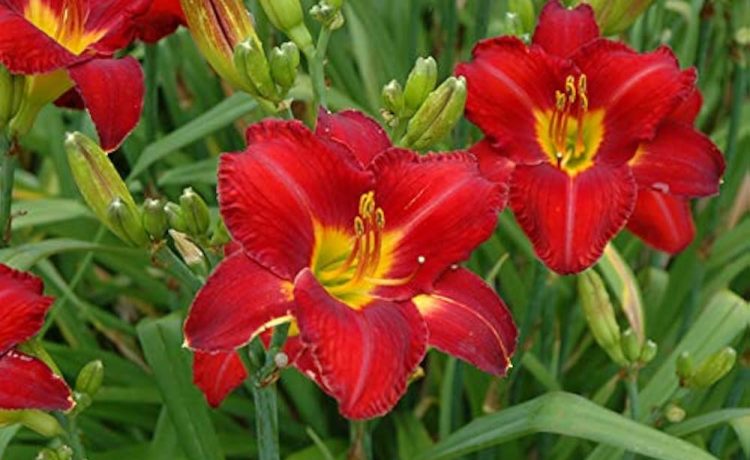
Crowning the selection, Hemerocallis ‘Berlin Red’ achieves 90cm with deep red funnels, golden throats, and yellow streaks. Tetraploid structure grants extra substance, blooming from July onward with weather resistance. Deciduous, it suits front-yard accents near white phlox, its richness undimmed by humidity.
This variety caps the seven, its longevity—up to six weeks—ensuring no early fade. Robust against poor conditions, it exemplifies AGM standards. Daylily plants for sale highlight it for bold statements, divisions propagating easily.
Extending beyond, mix these for continuous cover: early ‘Stoke Poges’ with late ‘Berlin Red’. Total input remains low; monitor for gall midge, but successes outweigh. In evolving climates, their adaptability secures future-proof gardens.
British plots benefit immensely, colour persisting amid uncertainties. These seven, grounded in trials, promise fulfilment for dedicated growers.